Showing posts with label book. Show all posts

Monday, October 12, 2015

A Taste of the East

I feel like I'm constantly ranting about how people always equate Jewish food with Eastern European food: matzoh balls and gefilte fish, bagel and lox.  I didn't try matzoh ball soup until college, was introduced to lox at a weekend sleepover in elementary school (and thought it was really weird; I've come around), and have yet to meet a gefilte fish I want to eat.

So, I wanted to share some photos from an event I participated in September.  Having had so many "yes, I'm Jewish, and no, I never tried matzoh ball soup until college" conversations, I jumped at the chance to demo a traditional Iranian Jewish recipe at A Taste of the East, a night welcoming Rosh Hashana -- the Jewish New Year, with flavors from The Middle East and Mediterranean.  It was a night of dinner, music, and storytelling, all celebrating the culture of Sephardic Jews.

LISA GRISSOM

I performed one of three demos of Sephardic Jewish food.  Orly Olivier of Petit Takett made Tunisian harissa, and Deborah Gorman of Sorbabe made bourekas–Turkish-Greek cookies filled with ground walnuts and dipped in a sweet syrup.  And I made faloodeh sib–a refreshing combination of rosewater and shredded apples that is the traditional Yom Kippur fast-breaking food among Iranian Jews.
LISA GRISSOM


LISA GRISSOM

It was a great time. I'd never done anything like this before, but cooking and chatting in an industrial kitchen with these ladies was a treat and an education, and sharing my family recipes with a warm, interested crowd, while being schooled on some foods that were new to me, felt wonderful.

NICOLE YOUNESI
As people milled through the space, I stood at a table decorated with black and white photos of my grandparents and shredded apples against a box grater, and then added sugar, water, rosewater, and ice to perfectly balance the rosewater's intense aroma with just the right amount of sweet.

30 YEARS AFTER
I had a couple friends, a few cousins, and my parents in attendance.  I was really happy to have these familiar faces in the crowd when we arrived at the storytelling portion of the evening.  I spoke about my uncle, a distinguished physician, affectionately known by his grandkids as "Lulu", who would leave Yom Kippur services at the synagogue early to go home and prepare faloodeh sib for his family. I wasn't the only one tearing up as we remembered this sweet man.


Recalling old memories of food and family, as we make new ones with new friends.  More of this, please.

Saturday, October 10, 2015

Mom's Polo Shevid Baghali in Lucky Peach


Those hands belong to my mom, Violet.  She is halving baghali, fava beans, for one of my favorite dishes of hers, polo shevid baghali.  I am beyond thrilled to report that I got to cook this dish with her, and interview her about her own food memories, for the Lucky Peach website's "We Love Mom" column.  I've loved Lucky Peach magazine since its inception, but always had a problem with the boy's club vibe that came off its mostly male, mostly restaurant chef writing.  This column is the opposite, as it celebrates traditional home cooking (though many of the moms, and other parents, profiled are far from traditional), and paints a broad ethnic picture of American kitchens today -- all with adorable old-school pictures of the writers and their moms.  Suits me just fine; happy to be a part of it.  Check out my story here!

Saturday, April 04, 2015

Scenes from an Iranian-American Passover Seder

I failed to take my good camera with me to my parents' house last night, but I had to share some quick phone snaps.  It occurs to me how unfamiliar a lot of people are with the Passover dinner that I know.  Nary a brisket, matzoh ball, or jellied, goopy ball of gefilte fish in sight.

Important distinction, in extremely broad strokes: there are two ethnic/geographic groupings of Jews: Ashkenazi and Sephardic.  The former originate in Eastern Europe, the latter from the Middle East and the Mediterranean.  Quick and dirty rule of thumb: Ashkenazi = white Jew, Sephardic = brown Jew. (Obviously, there are also Jews in Africa, East Asia, South Asia, and pretty much everywhere else.  But for the purpose of this post, Ashkenazi is the mainstream, and Sephardic is how I'm distinguishing myself from it.)

Jewish food as its known in most of the United States has nothing to do with what I grew up with.  Bagels and lox, pastrami on rye, knishes and the like all come from the Ashkenazi tradition. As a Sephardic Jew, and specifically an Iranian one, my cuisine matches where I come from: more spices and fresh herbs and vegetables, lots of sweet and sour flavors from using fruit in our savory dishes, and at this time of the year, the best distinction of all: unlike Ashkenazis, Sephardic Jews eat rice during Passover. Because we might starve otherwise.

Here are a few shots from my parents' house last night.

Fresh almonds to greet guests.  Green and fuzzy, crunchy and tart.
Each year for Passover, my mom buys the best nuts she can find, and washes, salts, sun-dries, and roasts them herself.  I've never had a better hazelnut (or forty) and I'm not above cherry-picking for them, especially if my sister is looming over my shoulder.  Last night, my mom served a mix of pistachios, hazelnuts, and almonds in this gorgeous silver bowl from Iran, inherited from my paternal grandparents.


Meanwhile, in the kitchen, my Auntie Mohtaram, my mom's oldest sister prepared nargesi -- an eggy casserole of fresh herbs and tiny meatballs* -- as her daughter, granddaughter, and great-grandson looked on.

Three kuku sabzis, on deck.  Among Iranian Jews, you use kuku sabzi -- a bright herby frittata with crisped edges -- for a memorial blessing.  Passover corresponds with the anniversary of the death of my maternal grandmother, so we remember her each year with kuku sabzi.

Whereas Ashkenazi Jews use horseradish as their bitter herb, we have a bitter lettuce (though admittedly this year's romaine was not the most bitter choice).  Where Ashkenazi Jews dip parsley in saltwater, we dip the pale inner stalks of celery into vinegar.  Our haroset recipe, long ago handwritten by my paternal grandfather for each of his kids, is a balanced blend of several nuts, fruits, spices, and wine.  Though we no longer grind meat at home, my dad pulls out the hand-crank meat grinder every year to give the haroset its perfect texture. And yes, Maxwell House hagaddah.  I mean, come on, we're still Americans.

Oh, we also run around the table whipping each other with scallions.


The full dinner spread -- almost.  You'll note that we're not even done setting the table, and there is already tahdig -- the crispy saffron rice from the bottom of the pot -- in people's plates. We really are polite people; it's just that hot of a commodity.

However you're celebrating, and whether you're celebrating, here's to expanding our worldview and eating well -- and at best, both at the same time.

--
* Note that Iranian Jewish nargesi, for whatever reason, is totally different dish rom the Muslim dish of the same name, though the latter looks delicious as well. 

Sunday, June 25, 2006

The Book, Auntie Mohtaram, and One Last Category


I have a personal project, to which I've only barely alluded on this blog. It's just the beginning, and I'm a little nervous about saying things like "I'm writing a book," when I'm not totally sure it's gonna happen (in the same way, when you're 16, you don't tell your friends you're taking the driving test until the license is in your hands... too scary!). As usual, it's a long story. Here we go...

This past Hanukkah, my friend Rachel got me a book called "The Book of Jewish Food", by an Egyptian Jewish woman named Claudia Roden. It's amazing (to me) in that about one-fourth of its 600 pages are devoted to Ashkenazi food, and the rest is Sephardic. It contains tons of recipes, but also a great deal of history, photos, personal stories, etc. about many different Jewish communities around the world. On top of all this goodness, the names of all the recipes are in their native languages (Italian, Spanish, Arabic, Ladino, etc.) which totally feeds my obsession with linguistics and the connections between languages. It's a very impressive tome -- so much research, so much information, and so much heart.

Having said that though, the amount of the book that is devoted to the Iranian Jewish community is pretty slim. Most of the Persian recipes are not specifically Jewish, but general Iranian dishes, and it appears her primary source is the Sisterhood recipe book from a synagogue in Skokie, Illinois.

This got me thinking -- there is *much* culture, history, heritage in the Iranian Jewish kitchen. So many stories and delicious recipes among my parents and grandparents alone. Additionally, it's a culture that's dying -- the number of Jews who still live in Iran is steadily decreasing, and those of us outside the country simply don't have lifestyles that can maintain the culinary tradition our moms and grandmas practiced on a daily basis. I felt there was a book to be written here. And I felt that I was in a unique position to write it. Granted I have no formal qualifications. But I am completely obsessed with food, and have access to many many Iranian Jews. And I am certainly well-versed on the consumption side -- I've read tons of cookbooks, and have eaten a LOT of food.

I mentioned it to a few close friends and family. Friends were excited and supportive. Family was mixed: sister and Mom thought it was a little crazy, but surprisingly, Dad was really excited. He started rattling off stories about about how the Shah of Iran would, on Saturday afternoons, go into Tehran's Jewish ghetto, where some elderly widow would make him the traditional Shabbat meal (not for any religious reason, just because it was delicious), and about how Iranian Jews have a battery of 'mezze' dishes, since theirs were the only households in the Muslim nation where you would find alcohol. Wow, I had no idea! Since then, I've started interviewing people -- people of my parents' generation and older, because they have memories of the foods/holidays/traditions from Iran.

Sunday, I visited my eldest aunt. At 77 years old, she is the oldest of 6 siblings, nearly 20 years older than my mom, the youngest. The two hours spent at her house were a truly memorable experience. First of all, before the storytelling even began, there was the hospitality. We (my mom and I, as well as my 4-month-old nephew who lives across the street) got there and she immediately started feeding us, and continued to do so over the course of our time there. First, she cut up a cantaloupe, and brought some wheat lavash bread to have with it ("I can't eat melon without a bit of bread", she told us). Next, an orange, then an apple, peeled and sectioned at the table, followed by a cucumber. Then tea, which she topped of with hot water halfway through because it may have gotten cold ("Water has to be cold, tea has to be hot"). Then pumpkin seeds and raisins, and finally a small container of cookies and sweets.

So we talked and talked and talked. She has a million recipes at the tip of her brain, measuring things in spoons and cups, but also in 'the size of two hazelnuts', or 'the shape of an egg'. Her perspective is different from my parents' -- her late first husband was from a town called Kermanshah, which is not far from the border with Iraq. Both of his brothers had wives of Iraqi Jewish descent, so she has a set of recipes for typical holiday dishes that varies considerably from what my mom, or her mom, would make. Sweets for Passover, all sorts of homemade preserves, 3 different types of halvah. She gave us the recipe for gondi torshi, sweet and sour rice balls that were the traditional Yom Kippur fast-breaking meal for her in-laws. Little did I know that she brought my mom gondi torshi in the hospital on the night after I was born to break her fast (yes I was born on Yom Kippur, and yes my mom fasted on her delivery day)! She started tearing up when she recalled memories of her own marriage at age 15, the tribulations of being away from her childhood home and being in charge of dinner for 6 in-laws, all the while nauseous with morning sickness (yes, I have cousins older than my mom). This woman has been through a lot, and she's eager to tell her stories. She was asking me if they make cassettes that are 2 hours long, so she can just get it all out. I think we can make this happen for her.

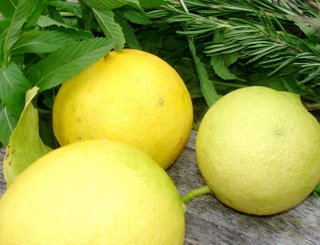
Before we left, she insisted that we do not leave empty-handed. You see, her backyard is an extremely well-kept garden. Surrounding her lawn are fruit trees, herbs, flowers, pots, trellises, and much to her dismay, gopher holes. She brought out a giant knife and hacked off fresh mint, rosemary, 2 types of lemons, and grapefruits for us to take home with us.

So thus begins the saga of the book. It's just the beginning, and I know I'm prone to starting projects I don't finish, but I really hope I can push through with this one.