Showing posts with label etymology. Show all posts

Tuesday, October 25, 2016

Slow-cooked Lentils: The heart wants what it wants

The other night, I was talking to a Lebanese-Australian guy at a bar (as one does). And as I do when confronted with an Arabic-speaker, I turned the conversation to language. He mentioned that the Arabic word for 'heart' is qalb, and it got me thinking.


While Arabic and Persian aren't from the same language family, Persian picked up a lot of Arabic words at the time of Arab Conquest. Basic, fundamental things in the language are pure Persian, but there's plenty that was built on top of that foundation, much later, that comes from Arabic.


So, I was surprised: qalb is the Persian word for 'heart', too. You'd think that the word for this most essential body part would predate, well, pretty much everything. But it's a little complicated: In Persian, when you talk about the blood-pumping physical organ in the middle of your chest, you use qalb. But when you talk about the thing that pangs when you have a crush, the part of you that pulls when a friend is hurting, the word is del, and del refers to the stomach.


Anatomically speaking, del is a Persian word for stomach. There are others, but when you have a stomachache, it's your del that hurts.  But when it comes to what English-speakers know as matters of the heart, in Persian, they sit squarely in the del, the stomach. When you're forlorn and missing someone, you're deltang  your del feels tight, not your qalb. When you sympathize with someone's misfortune, you're delsooz — your del burns for them. When you're overflowing with emotions and need to vent, your del is por, or full. And when someone talks you through your sadness and makes you feel better, they are your deldar — they have your del.  And of course, that hottie walking down the street? That's a delbar, one who takes your del.


It's weird at first to think of the belchy, acid-filled stomach as the seat of our most exalted feelings, but the more I think about it, the more it makes sense.  In a culture where food is a tool of healing, a justifiable labor, the fruit of creativity, the foundation of the family home, and the deepest expression of love, of course the stomach is where emotion lives. When you peel away external influences, the unadulterated core of Persian emotion is this perfect heart-stomach hybrid.*


In Persian, when you don't just off-hand want something, but really, really want it, you say that your del wants it. The last couple months have been an whirling blur of jetlag, illness, a birthday, holidays (times two), wrap parties, hangovers, and so much amazing travel.  After all this indulgence, all my del wants is the simplest preparation of lentils.  The Persian word for lentil is adas (also from Arabic, it turns out), and adorably, lentil soup is adasi. There are plenty of adasi recipes with various vegetables and spices, but simply simmering humble brown lentils forever with nothing but salt and pepper imparts a suprisingly complex flavor. It's typically served in shallow bowls sprinkled with ground golpar or oregano to help with digestion, and most commonly for breakfast. I love adding a knob of butter to the center of my bowl and watching it melt into liquid gold.

Pure nourishing comfort — exactly what my heart, and my stomach, want.

* We know that del is truly Persian, because we see it in its Indo-European cousins, such as Hindi, which has the word dil, which of course, we know from the 1998 movie Dil Se ("At Heart"), which gave us this most amazing Bollywood moment ever.


Adasi | Persian Slow-cooked Lentils
Makes 8 servings

The actual cook time is a bit fudgy in this recipe: depending on how long you soak the lentils and the type of lentils you use, it can vary from about 45 minutes to two hours. If you use a pressure cooker, you can get them done in about 20 minutes. What you're looking for is a creamy, almost spreadable texture, with very little loose liquid and soft but not completely broken down lentils.

2 cups green or brown lentils
1 teaspoons salt, plus more to taste
1/2 teaspoon black pepper, plus more to taste
1 teaspoon ground turmeric (optional)
1 teaspoon ground cumin (optional)

Garnishes
butter
dried oregano
ground golpar or oregano

Add lentils, 5 cups water, and salt to a large bowl and stir to combine.  Soak lentils for at least two hours, up to overnight.

Move lentils, with their water, to a large pot. Add pepper and turmeric, if using, and bring to a boil. Lower heat to a lively simmer, cover and cook, stirring approximately every 15 minutes, until lentils reach desired consistency. Adjust seasoning to taste.

Serve steamy hot with a sprinkle of oregano or ground golpar and a big knob of butter.

Tuesday, September 20, 2011

Punch Day!

Judy_Punch Bowl 68
Leave it to me to take something totally insignificant, and turn it into something totally nerdy.  Hard-hitting reporting, that's what we do here..

Anyway, as everyone who's anyone probably already knows, today is National Punch Day.  But what you may not have known (excited yet?) is the origin of the word punch!  As we learn from punchbowl.com, the word punch comes from the Hindi panch, which means five.  This was in reference to the original five ingredients in this exotic drink that traders with the British East India Company brought to England from the east:  spirits, water, lemon juice, sugar, and spice -- which actually sounds pretty delicious.  Who knew?!

(Note: Punchbowl.com informs us that this week is also National Singles Week.  It could be my excitement over stuff like this that keeps me celebrating that holiday as well....Sigh...)

--
thanks to Old Shoe Woman for the photo!

Monday, June 27, 2011

Blowing Your Mind With Crisco

Crisco Shortening, 1950's
I've recently discovered Google Reader (because I live in 2004 apparently), and it has changed my life.  Rather than spending hours reclicking on the countless blogs I love just to check if there is anything new, now I just go to this one simple place and get a continuous, constantly updating feed of new posts from all of my blogs.  It's amazing.  And it's so efficient that sometimes I don't know what to do with myself, what with all the time I've saved by not hitting refresh all over the place.  Fortunately, it also recommends posts for me, so the procrastination truly can go on forever.

And today, these very recommendations led to an etymology post!  That old nerdy favorite that no one cares about but me.  First one since 2008 (not that you care)!  Unlike most of the etymology posts, this one comes from our own English language.  But, like all of them, it's based on hazy and vague sources, and may not actually be true.  Meh, undeterred.

It comes from Chris Loves Julia, the blog of a sweet young family in Utah, from a post about a fine local pizza joint with reverence for the true meaning of shortcake:

"Most often when we hear someone talking about strawberry shortcake, what they are referring to is angel food cake topped with macerated strawberries and whipped cream from a can. When a cake or bread is referred to as "short," what that means is there has been something added to the mix to shorten the gluten strands (gluten is the protein found in flour, and just like protein in meats, it forms long, elastic strands). Things that shorten gluten strands include Crisco (also referred to as "shortening"- did I just blow your mind?), oil, and butter. The fats get in the strands of gluten and break them apart, creating a crumbly texture." 

What?!  This is what shortening is all about, shortening of gluten strands?  Yes, Chris Loves Julia, you have totally blown my mind.  This is amazing.  And I want shortcake.

--
thanks to Roadsidepictures for the photo

Thursday, August 28, 2008

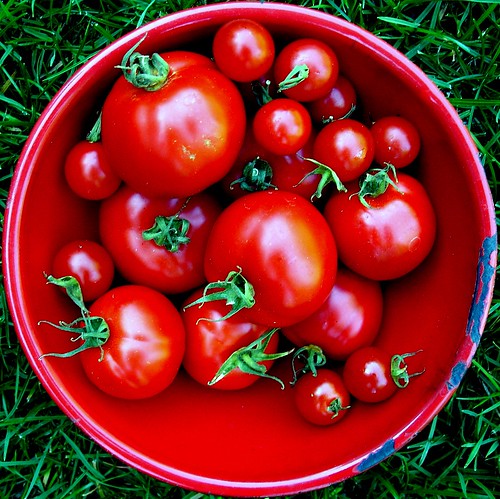
Love Apples

An etymology post! Remember those?! They're my secret nerdy favorite.

So last night, I went to an amazing dinner and talk featuring Fallen Fruit, an organization that you all should learn about. More on that later though (UPDATE!); let's focus on a detail. As Matias Viegener, one of the Fallen Fruit guys, spoke about the many varieties of tomato we were about to chow down on, he mentioned that one was called Love Apples.

(I should note that nothing from this point on is fact: for one, I feel like pretty much all etymology is speculation -- it's very rare you find consensus on a word's origin, and for another, I'm completely spazzy on the details here. The word origin stories are still lovely though, even if they're just true-ish.)

Anyway, apparently, this is what tomatoes were called when they were introduced to the English language: love apples. Why, you ask? Because, well, the Brits first learned about tomatoes from the Italians, who of course call them pomodoro, and mistakenly thought the word was derived from adorare. Actually though, the word more likely derives from d'oro, as in "golden apple" (a sweet reminder that red is just one of the many colors tomatoes can be), or de Moro, "apple of the Moors". Either way, I had never made the apple-tomato connection within pomodoro; I think it's pretty cool.

(Now that I think about it, one day we should talk about the apple-potato connection, which oddly/awesomely comes up in quite a few seemingly unrelated languages. People, get excited.)

[thanks to jackie-dee for the gorgeous tomato photo]

Sunday, December 31, 2006

Cheese on Horseback

A weird cheesy-etymology coincidence happened yesterday. I received Wanda and Giovanna Tornabene's Sicilian Home Cooking for Hanukkah, a great book which couples simple, delicious-sounding recipes with saucy stories from the Tornabene family's matriarch (more on that soon, no doubt). Poking around in the book yesterday, I kept coming across recipes contain the ingredient caciocavallo. I kept thinking it's some cabbagey product only available in Italy, like cavolo nero, but quickly figured out it was cheese.

Then, unrelatedly, I found myself on the website of Alcazar, a Lebanese restaurant in Encino (whose name, incidentally, was the source of another etymology revelation long long ago... ah the geeky memories). There it was on the menu, k'llej kashkaval: kashkaval cheese grilled in pita bread.

First of all, yum. Secondly, the very reason Sicilian cuisine interested me was its connection to the Middle East, and here it was -- obviously these words are related. Thirdly, when we made the cheese map, we had noticed that while most of Mediterranean Europe use a cheese world inherited from the Latin caseus, Italy uses formaggio, relating to the fact that its cheeses are often formed in a mold.

Well, not so with caciocavallo. It apparently means 'cheese on horseback', and clearly the 'cheese' part is a caseus-related word. It's not formed in a mold, but in cheesecloth, in teardrop-shaped pairs. And it's on horseback, either because it hangs on a 'saddle' to dry, or because of how it was originally transported. Cute.

It's funny, I was thinking the other day how I hadn't come across any fun etymology items lately, and one found me.

Happy New Year everyone! Here's to a 2007 filled with peace and cheese! (Unless you're lactose-intolerant, or vegan. In which case, peace and chocolate!)

Friday, August 18, 2006

the whole enfrijolada

my head's kind of exploding right now. so... I was reading about an oaxacan restaurant in eastern ktown here, which linked to this page here. the second link is a disambiguation between 3 oaxacan menu items (none of which i've ever heard of, sadly .. i've gotta work on this oaxacan thing): enmolada, entomatada, and enfrijolada.

the response from snackish is genius! the idea is, they're all tortillas dipped in (or surrounded by) stuff. an en-frijol-ada, for example, is dipped in beans (frijoles), the en-mol-ada, in mole.

so... snackish then relates it to one we all know really well.... enchilada. which is, of course, surrounded by chile sauce. it's like a tortilla that's been enchilied.

dude.

this got me thinking, are there others? the only one I can think of that sounds related is empanada (i know it's 'em', not 'en', but they are often interchangeable). but it totally works.. pan is bread, and what is an empanada but stuff surrounded by bread (and then deep fried to greasy crispy flakey goodness mmmmm...).

it boggles the mind. really.

Saturday, July 22, 2006

apricocious

Albaricoque is the Spanish word for apricot. When a Spanish word starts with 'al', you can guess it comes from Arabic (like alcázar, albóndiga, alfombra). Which, if you're me, means it requires further research.

This is a fun one. The word comes from the Arabic word for plum, al-barquq. It means "early-ripening fruit", and can be traced back to the Latin word praecox. From here, we step forward to our own English word precocious, said of a child who has ripened, or matured, early. I'm really excited: apricot to precocious? Wowee!

Some other things about apricot words:

- Weird that these days the Arabic is totally different. The word for apricot in Arabic, as well as in Hebrew, is mishmish. How can you not adore a fruit called mishmish!? Oh little precocious mishmish, can I pinch your little rosy cheeks before I eat you?
- Weird that the Persian is also totally different. In Persian, it's zardaloo. Zard is yellow, aloo is plum.
- Weird that in Hindi, aloo is not plum, but potato.


guys it's hot. really hot. i think i'm melting.

Thursday, June 22, 2006

from meatballs to hazelnuts

A while back, I was in some ethnic market, and saw a can of beans that said alubia on it (as part of the spanish text). I was really excited because lubia is the word for bean in Persian. First of all, I had never heard this word -- the only word I knew for bean in Spanish was frijol. Secondly, it's rare to find connections between Persian and Spanish. Because of the 'a' at the beginning of the Spanish, I assumed in this case that the link was Arabic.

Of course, I went to the trusty intertron to corroborate. And I found a great Spanish etymology site. And along with more on alubia, I found another one that kind of blew my mind. Albóndigas. As in the little meatballs in the soup. As expected, also comes from Arabic. But. Arabic for what? Apparently, bunduqa or something like that is the arabic word for hazelnut. The small round shape of the meatball is like a hazelnut. But. The Persian word for hazelnut is fandoq. Clearly related to bunduqa. How random -- a connection between the Spanish for the little meatballs you get with the stiff/cheap/delicious margaritas over at El Coyote on Beverly and the hazelnuts my mom has been drying, roasting, and salting herself every year for Passover so as to be absolutely sure that outside processing has left them with no trace of leavening. Pretty cool -- to me anyway...

Anyway, here's the site: www.etimologias.dechile.net

Sunday, June 18, 2006

the world in cheese

I have a minor obsession with languages, and have been lucky enough to find friends who are also obsessed. For me, it's fun to find connections between different countries' words -- I can sit for hours and find cognates between Persian and Arabic (and have done just that on many many many occasions!). I get thrilled when I discover new ones (some examples: the 'an orange'/'naranja'/'narenji' connection, and the 'aubergine'/'berenjena'/'badenjan'/'bitingan' one). There are even a couple that are so cool and run so deep that they deem their own (eventual) post.

So you can imagine my excitement when, at work a few weeks back, the lunchtime conversation turned to the words for bread and cheese in every language. Between the 5 of us, we were able to come up with English (doy), French, Spanish, Italian, German, Swedish, Japanese, Korean, Mandarin, Tagalog, Persian, Hebrew, Arabic, Hindi. Interrogating some coworkers (is it weird to randomly go up to someone and ask them how they say cheese in their native language? probably. oh well), we added Turkish, Armenian, Flemish, and Dutch to the list. That's 18 languages!

But this was just the beginning of the fun. We came back to our desks, and my friend Brian made a stop at mine. Apparently 18 languages was not enough for him. He started rattling off many others (basically all the European languages), and I diligently scoured google for the cheese word in each one. Meanwhile, Brian was drawing a map, freehand, of Europe -- a glorious cheesemap! It was really impressive -- kind of a genius document. There might truly be world peace if we could just put away our differences, and focus on our amazing common ground -- cheese (sorry lactards).

Some things we learned:
  • Much of Mediterranean Europe's cheese word is in the 'queso' vein (like 'cheese' itself). Makes sense, the Latin for cheese is 'caseus'. BUT -- what happened to Italy and France ('formaggio' and 'fromage', respectively)? Turns out, this has to do with 'shape, form, mold' -- perhaps because these countries were actually making cheeses in a mold, as opposed to just curds in a bag?
  • Hebrew is 'gvina', Arabic is 'gibn'. Stands to reason they would be related. (Also, come on people! You guys have the same word for cheese -- can't we all just get along?) BUT -- the Gaelic word is 'gobin'. Wha?? Why would they be related?
Anyway, here is the cheese map, complete with coffee stain. Study it well and meditate on world peace through cheese.


Also: Here's a comprehensive list of cheeses the world over, and a fun etymology page.

Wednesday, May 17, 2006

salami taxonomy

2 amazing italian food etymology items. my heart is heavy with excitement:

1: From that genius of cooking, both haute cuisine and weeknight dinner, Sara Moulton:

In one way or another, lasagne seems to derive from the classical Latin laganum. But what was laganum? Something made of flour and oil, a cake. The word itself derived from a Greek work for chamber pot, which was humorously applied to cooking pots. And like many other, better-known cases of synecdochical food names, the container came to stand for the thing it contained. And eventually, by a process no one knows with any certainly, laganum emerged as a word for a flat noodle in very early modern, southern Italy. If you are persuaded by all the evidence collected by Clifford A. Wright, you will be ready to believe that in Sicily, an Arab noodle cuisine collided with the Italian kitchen vocabulary and co-opted laganum and its variant lasanon to describe the new "cakes" coming in from North Africa. Would you be happier about this theory if you had evidence of a survival of an "oriental" Arab pasta in Sicily? Mary Taylor Simeti provides one in Pomp and Sustenance, Twenty-Five Centuries of Sicilian Food. Sciabbo, a Christmas noodle dish eaten in Enna in central Sicily, combines ruffled lasagna (sciabbo-jabot, French for a ruffled shirtfront) with cinnamon and sugar, typical Near Eastern spices then and now.

Greek and Arabic connections to lasagna? Wow! And cinnamony lasagna? YUM! Sounds like my middle eastern mother's spaghetti sauce recipe. Here's the foodtv page this came from (with lasagna al forno recipe).

2: This one is from a somewhat sad New York Times article about dry-cured salami, and how restrictive Health Department guidelines are sending this millenia-old artisanal specialty to extinction:

The process of curing meat has been refined over thousands of years by people who are on intimate terms with their handiwork. Food historians believe that the Romans picked up the craft from the Lucanians, a tribe that for almost 1,000 years ruled part of what is now Basilicata in southern Italy, developing a reputation for sausages while fending off imperial conquerors. The Greek sausage loukanika and its Mediterranean cousins the longaniza (Spain), luganega (Italy), and linguiça (Portugal) are all descendants of the ancient lucanicus.

I would never have discerned a connection between loukanika and linguiça. Here's the article (you'll probably need to register.. but you know about bugmenot.com, right?).

Ahh food etymology, you never fail me.